
Understanding MUDs in the Lake Houston Area
What a Municipal Utility District Is, How It Works & Why It Matters When You Buy
MUDs are the quiet backbone of Texas’s growing communities, and one of the most misunderstood lines on a property tax bill. Here’s a clear, positive explanation of what they are and what they mean for you.
★ 5.0/5.0
44 Client Surveys (HAR.com)
10+
Years Local Experience
Local Broker
Kingwood-Based, Not a Franchise
NAR • BPOR • SFR • ALHS
Certified Broker
What Is a MUD?
When you drive through a thriving Texas neighborhood, water flows, toilets flush, and streets stay dry during heavy rain, and a Municipal Utility District is often the reason. A MUD is a special-purpose district created under Texas law to provide essential utilities and infrastructure within its boundaries: water, wastewater, and drainage, and frequently roads and parks too. Think of it as the unsung hero that makes a brand-new community livable from day one. Districts are established by petitioning the Texas Commission on Environmental Quality (TCEQ) or through legislative action.
MUDs matter because they solve a real problem: rapidly growing cities and counties often can’t extend water and sewer mains fast enough to serve large new developments. Rather than force existing taxpayers to fund that growth, a MUD lets the new community pay for its own infrastructure over time. That’s why MUDs are so common in the booming suburbs around Houston, Austin, and Dallas, and throughout the Lake Houston, Porter, and Montgomery County areas around Kingwood. If you’re weighing where to buy, our property-tax and city-vs-county guide puts MUDs in the context of your whole tax bill.
Why MUDs Exist, and Why That's a Good Thing
MUDs are a genuine game-changer for community building, for three reasons. First, financing: a MUD raises money by issuing tax-exempt bonds, so essential infrastructure gets built without saddling developers, or existing city taxpayers, with the full upfront cost. Second, growth: by delivering utilities and drainage, MUDs make it possible to create new residential, commercial, and industrial neighborhoods where there was once raw land. Third, local control: a MUD is governed by residents of the district, which tends to make services responsive and tailored to the community it serves.
There’s an important wrinkle worth understanding, especially around Kingwood. A MUD can sit inside a city’s limits or in unincorporated county. Inside city limits, residents typically pay both the city property tax and a separate MUD tax that repays the infrastructure bonds, while still receiving full municipal services like police, fire, and libraries from the city, the MUD simply handles the utilities and debt. In unincorporated areas, the MUD often carries more of the service load. Either way, the district remains a separate political subdivision with its own elected board, even when it sits inside a city.
Understanding MUDs, At a Glance
Click to view full size.
How a MUD Works, Step by Step
A District Is Formed
A developer petitions the TCEQ (or the legislature) to create the district so a new community can be built with proper utilities and drainage.
Bonds Fund the Build
The MUD issues tax-exempt bonds to pay for water plants, sewer and drainage systems, and often roads and parks, infrastructure in the ground before homes are sold.
Residents Repay Over Time
Homeowners repay those bonds through a MUD property tax, set publicly each year, so the community, not existing city taxpayers, funds its own growth.
An Elected Board Governs
A five-member board of directors, elected by residents, sets the rate and oversees operations in open meetings, with independent audits required every year.
Infrastructure Is Maintained
The MUD operates and maintains the water, sewer, and drainage systems, delivering reliable day-to-day service to the neighborhood.
Rates Decline as Debt Is Repaid
As bonds are paid off and more homes share the cost, the MUD tax rate falls over time, often significantly, which is the part that most benefits long-term owners.
The Truth About MUD Taxes
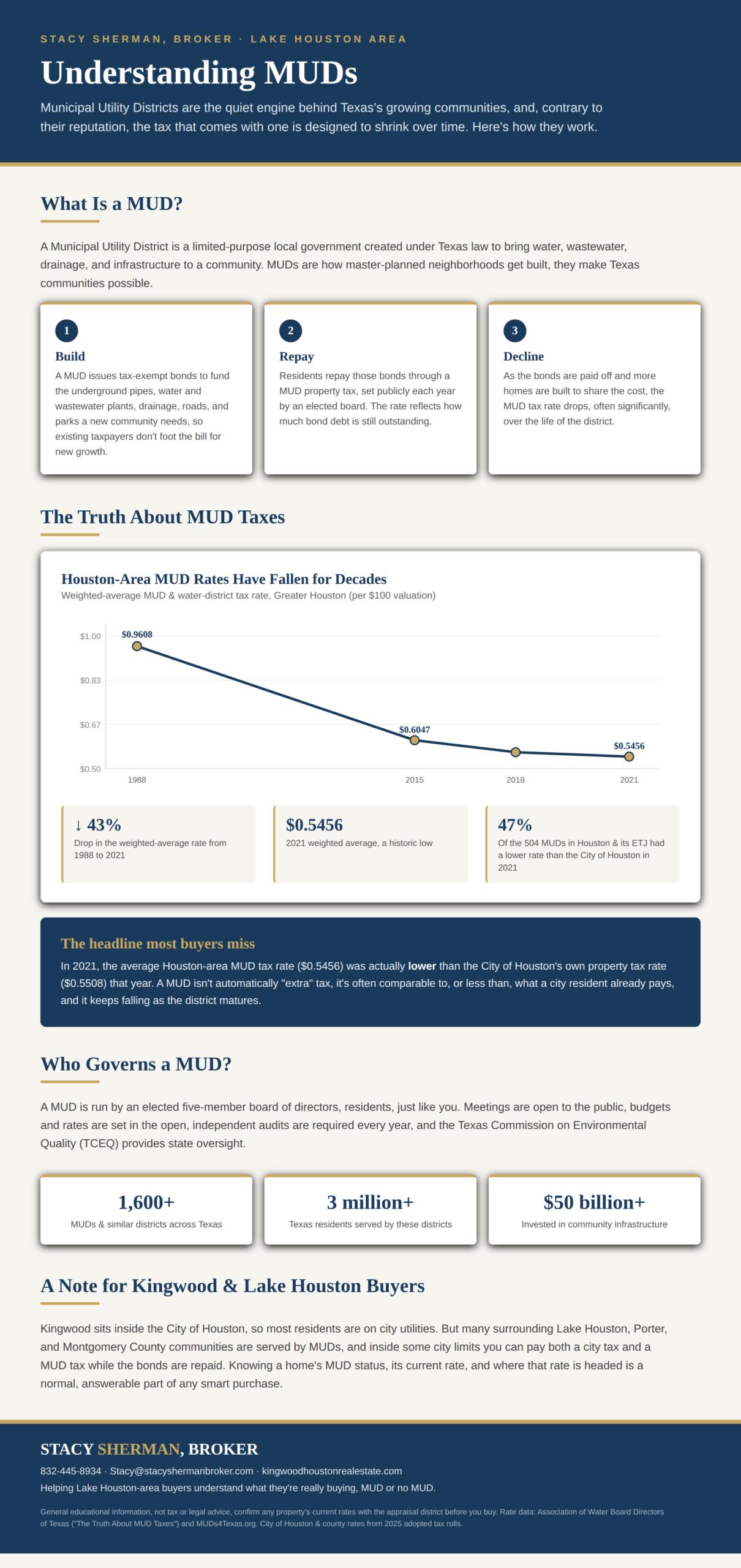
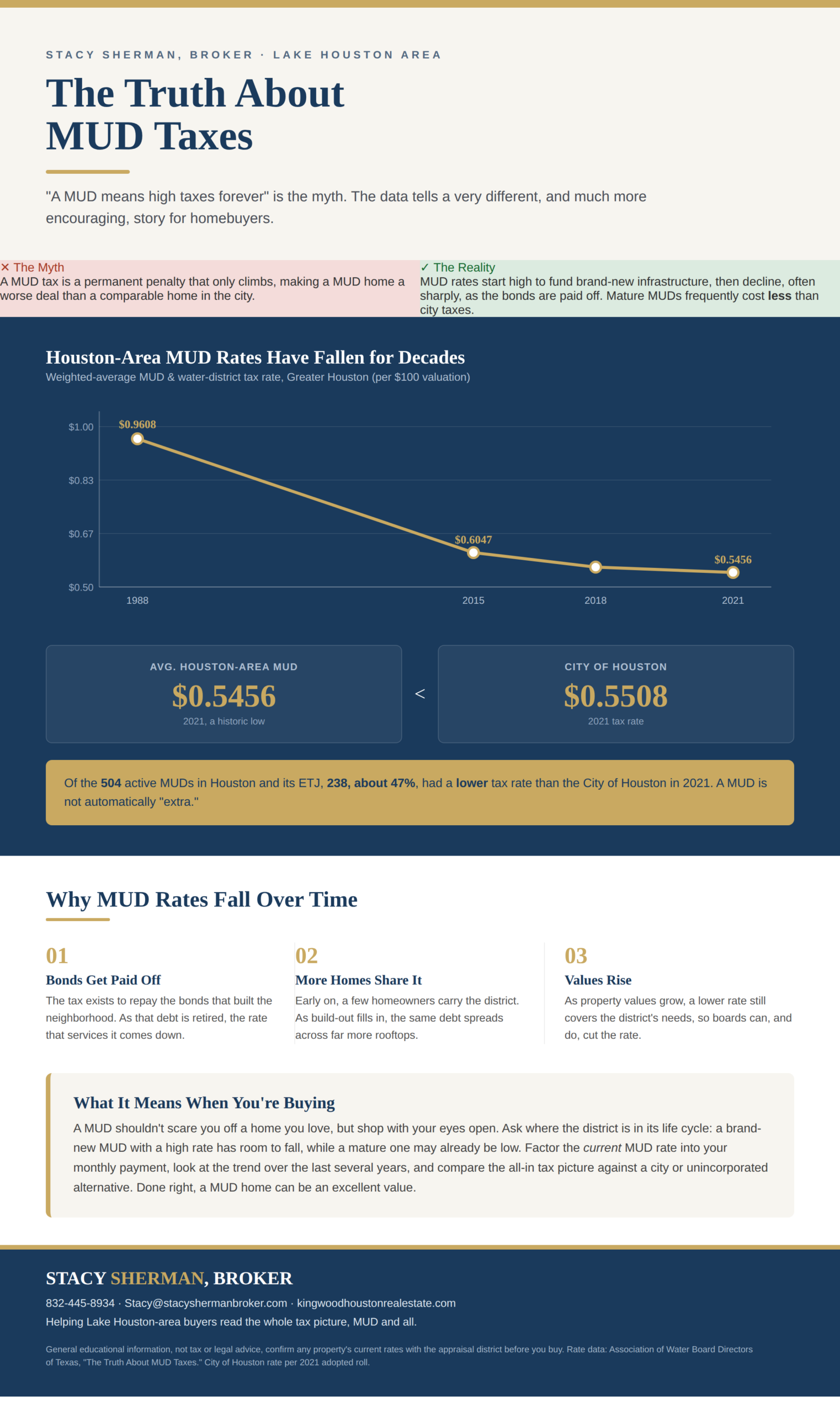
The single most important thing to know about MUD taxes is also the most reassuring: they are designed to go down. A MUD rate starts high because a handful of early homeowners are shouldering the cost of brand-new infrastructure. As the bonds are paid off and the neighborhood fills in, that cost spreads across far more rooftops and the rate declines. Across Greater Houston, the weighted-average MUD tax rate fell from about $0.96 per $100 in 1988 to a historic low of roughly $0.55 by 2021, which that year was actually just below the City of Houston’s own property tax rate.
In fact, of the roughly 504 active MUDs in Houston and its extraterritorial jurisdiction, about 47% had a lower tax rate than the City of Houston in 2021. So a MUD is not automatically an “extra” burden, in a mature district it can cost less than living in the city, and it’s always funding something tangible: the water you drink and the drainage that protects your home. For how this plays into an actual purchase, see our companion post on MUD taxes and your home-buying decision.
The Truth About MUD Taxes, The Data
Click to view full size.
MUDs, SUDs & Other Texas Districts
MUDs are the most common district you’ll encounter, but they’re part of a broader family of Texas special districts, and it helps to know the differences when you’re reading a tax bill or a listing. The label on a district tells you a lot about what it does and how it charges you, some levy a property tax, others bill only through your monthly water fees, and a few focus heavily on flood control and drainage rather than day-to-day utilities.
For a homebuyer, the practical takeaway is simple: don’t assume every acronym means the same thing on your tax bill. A home served by a MUD or WCID will usually have a district tax line; a home on a SUD generally won’t. When you find a home you like, we’ll identify exactly which district serves it and what that means for your all-in cost, the same way our property-tax guide walks through the rest of the stack. The quick reference below covers the districts you’re most likely to see around the Lake Houston area.
Types of Texas Water & Utility Districts
| District | What It Does | How It's Funded |
|---|---|---|
| MUD (Municipal Utility District) | The most common suburban district, finances and builds brand-new neighborhoods' water, sewer, and drainage. | A separate property tax plus a monthly utility bill. |
| SUD (Special Utility District) | Provides drinking water and sewer service to rural or underserved areas; often a former non-profit water co-op turned public. | Monthly water/utility fees only, usually no property tax. |
| WCID (Water Control & Improvement District) | Similar to a MUD but can buy existing infrastructure; often heavily focused on flood control, dams, and drainage. | Property taxes and utility fees. |
| FWSD (Fresh Water Supply District) | An older, narrowly focused district that delivers clean drinking water to a specific local area. | Property taxes and/or water fees. |
The Life Cycle of a MUD
It helps to picture a MUD as having a life cycle, because that’s what explains the tax you’ll pay. In the early years, the district has issued bonds to build infrastructure but only a handful of homes exist to share the cost, so the tax rate is at its highest. As the developer keeps building and homes fill in, that same debt is spread across more and more rooftops, and the rate begins to ease. Over time the district pays down and sometimes refinances its bonds, and the rate steps down further, often reaching a fraction of where it started.
In a fully mature MUD, the rate can be very low, and in some cases a district that has retired its debt and been absorbed by a city winds down entirely. The practical lesson for a buyer is simple: a MUD’s rate is a snapshot of where the district is in that life cycle, not a permanent verdict. A high rate on a brand-new district signals room to fall; a low rate on an established one may already reflect a nearly paid-off system. Neither is inherently good or bad, what matters is understanding the trajectory, which is the whole point of our MUD taxes and home-buying guide.
How to Research a Specific MUD
Identify the District
Find the MUD's name and number on the property's appraisal-district record and on the seller's required MUD notice.
Pull the Current & Historical Rate
Look up this year's tax rate and the last several years, a steady decline is exactly what you want to see.
Check Outstanding Bond Debt
A district with lots of bonds still to repay has a higher rate with more room to fall; one nearing payoff may already be low.
Read the District's Website & Audit
Texas MUDs post budgets, meeting minutes, and independent annual audits, a quick look tells you how the district is run.
Note the Utility Rates Too
Beyond the tax, the MUD sets your monthly water and sewer rates; factor those into your cost of living, not just the tax bill.
Ask About Upcoming Bond Elections
New bonds can fund more growth but affect future rates, a fair question for the district or your agent before you buy.
The Bigger Picture: MUDs Across Texas
It is easy to think of a MUD as a quirk of your particular neighborhood, but they are woven through the whole fabric of growing Texas. More than 1,600 MUDs and similar districts operate across the state, serving over three million residents and having invested more than fifty billion dollars in the water, wastewater, drainage, and road infrastructure that made those communities possible in the first place. When you buy in a MUD, you are joining a well-established, state-regulated system, not an experiment.
There is also a quiet reason MUD taxes tend to stay lean, and it is worth knowing. A typical MUD has few or no employees of its own. Instead of a standing payroll, most services are delivered by professional consultants working under contract, which keeps administrative overhead low and means a MUD does not carry the pensions, benefits, and long-term staffing costs that many other forms of government accumulate over time. Rather than leaving behind unfunded liabilities, a MUD leaves behind what its own advocates call legacy infrastructure: the pipes, plants, and drainage systems that keep serving the community for decades after the bonds are paid off. For a homeowner, that is a genuinely reassuring model, essential services delivered efficiently, overseen by an elected board and independent annual audits, and paid for by a bill that gets smaller over time.
Frequently Asked Questions
What exactly is a MUD?
A Municipal Utility District is a special-purpose local government created under Texas law to provide water, wastewater, drainage, and infrastructure within its boundaries. It’s how many new Texas neighborhoods get built, and it’s overseen by the TCEQ and an elected resident board.
Do I pay both city and MUD taxes?
If your MUD is inside a city’s limits, typically yes, you pay the city tax and a separate MUD tax, but you also receive full city services like police and fire. In unincorporated areas there’s usually no city tax, and the MUD carries more of the load. Our property-tax guide breaks down the full stack.
Do MUD taxes ever go away or go down?
They generally go down. MUD rates start high to fund new infrastructure and decline as the bonds are repaid and more homes share the cost. Some mature districts have very low rates; a few eventually retire their debt entirely.
Who runs a MUD?
A five-member board of directors elected by the district’s residents. Meetings are open to the public, rates are set openly each year, independent annual audits are required, and the TCEQ provides state oversight.
Is buying in a MUD a bad idea?
Not at all, it just calls for eyes-open shopping. A MUD funds real infrastructure, and rates trend down over time. Check the current rate, its recent trend, and how far along the district is in repaying its bonds, and fold the number into your budget. Our post on MUD taxes and your home purchase walks through exactly how to weigh it, and you can always reach out for help on a specific home.
What's the difference between a MUD and a SUD or WCID?
A MUD builds and finances new-community infrastructure via property taxes and utility bills; a SUD usually serves rural areas with no property tax (fees only); a WCID is MUD-like but can buy existing systems and often emphasizes flood control. See the comparison table above.