
Property Taxes, City Limits & MUDs
A Plain-English Guide to What You Pay, and Why, Across the Lake Houston Area
City of Houston or unincorporated county? Inside a MUD or not? Where you buy shapes your tax bill, your services, and your options. Here’s an honest, positive look at how it all fits together, so you can buy with confidence.
★ 5.0/5.0
44 Client Surveys (HAR.com)
10+
Years Local Experience
Local Broker
Kingwood-Based, Not a Franchise
NAR • BPOR • SFR • ALHS
Certified Broker
Where You Live Shapes What You Pay
One of the most common questions we hear from buyers moving around the Lake Houston area is some version of “why is the tax bill on this house so different from that one?” It’s a great question, and the answer usually comes down to three things: which county you’re in, whether you’re inside a city’s limits or in the unincorporated county, and whether the neighborhood sits inside a Municipal Utility District, or MUD. None of these are good or bad on their own, they’re trade-offs, and understanding them turns a confusing tax bill into a clear, comparable number you can plan around.
This guide walks through all three. We’ll look honestly at the pros and cons of being inside the City of Houston versus unincorporated Harris County, break down exactly what your property tax bill is made of (and cite current rates), compare Harris and Montgomery County, and demystify MUD taxes, what they are, what they fund, and what to expect if your home is in one. Our goal isn’t to talk you into or out of anything; it’s to make sure you know what you’re buying. For a deeper dive on the MUD question specifically, see our companion guide, MUD taxes and your home purchase.
Kingwood, Annexation & the Muscle of the City
Longtime residents remember Kingwood before it was annexed into the City of Houston in the mid-1990s, and there’s real nostalgia for those days. The community had a tight-knit, self-governed feel, and some of what made Kingwood special in that era is genuinely missed. It’s fair to say the trade-offs of annexation are still debated at more than a few dinner tables.
But pull the camera back and there have been definite wins. A community the size of Kingwood needs serious infrastructure muscle, and being part of the City of Houston has brought resources to bear on the challenge that matters most here: drainage and flood mitigation. After the hard lessons of recent storms, having the city’s engineering and capital behind large-scale drainage work has been critical, the kind of project that’s simply hard to fund at a neighborhood scale.
The honest ledger has entries on both sides. EMS response, once run by beloved local volunteers, feels less personal than it did, and city police coverage can be stretched thinner across a big service area than many residents would like. Those are real. But so are the wins, the infrastructure investment, the drainage progress, and the services a major city can provide. The point of this section isn’t to settle the debate; it’s to show that “city vs. county” is a genuine set of trade-offs, not a simple better-or-worse.
City of Houston vs. Unincorporated Harris County: The Trade-Offs
When a home sits inside the City of Houston (as Kingwood does), residents pay a city property tax and, in return, receive full municipal services, city police and fire, code enforcement, libraries, parks, and city-run water, drainage, and capital projects. In unincorporated parts of the county, there’s no city property tax line at all, which can mean a lower headline rate; in exchange, some services are thinner or provided differently, sheriff’s patrol and constables rather than a city police department, ESD-based fire and EMS, and utilities delivered through MUDs or other special districts rather than a city.
City vs. Unincorporated, At a Glance
| Consideration | Inside the City of Houston | Unincorporated County |
|---|---|---|
| Property tax | Includes a city tax line (~$0.52/$100 in Houston) | No city tax; often a MUD tax instead |
| Police | City police department | County sheriff & constables |
| Fire / EMS | City fire department | Emergency Services Districts (ESDs) |
| Utilities & drainage | City water, sewer & drainage / capital projects | MUD or special district provides water, sewer & drainage |
| Rules | City ordinances, permitting & code enforcement | County rules + deed restrictions (no city zoning) |
| Big-project muscle | City engineering & capital for large drainage/road work | Depends on county & district resources |
What Your Property Tax Bill Is Actually Made Of
Your annual property tax isn’t one tax, it’s a stack of separate rates from every taxing entity that serves your address, each expressed per $100 of taxable value. For a typical Kingwood home inside the City of Houston and Humble ISD, the stack in 2025 looks roughly like this: Humble ISD $1.1052, City of Houston $0.5192, Harris County $0.3853, Harris Health (the county hospital district) $0.1876, Harris County Flood Control $0.0497, the Port of Houston $0.0059, and the county Department of Education $0.0048. Add those up and you’re around $2.26 per $100 of taxable value, before any homestead or other exemptions, which lower what you actually pay.
Two things jump out. First, the school district is by far the largest slice, nearly half the bill, which is true almost everywhere in Texas. Second, notice there’s no MUD line in that Kingwood example, because most of Kingwood is on City of Houston utilities. In a neighborhood served by a MUD, that MUD rate would be added to the stack (and, as we’ll see, it’s designed to shrink over time). Encouragingly for local buyers, Humble ISD has actually held or trimmed its rate in recent years, and the City of Humble and Harris County entities publish their rates openly each fall.
Harris County vs. Montgomery County
Cross into Montgomery County, think Porter, New Caney, Conroe, and the master-planned communities north of Kingwood, and the math shifts. Montgomery County’s own rate (about $0.3770/$100) is similar to Harris County’s, and a typical Conroe-area homeowner’s all-in rate lands around $1.91/$100 before a MUD. Buyers sometimes assume “Montgomery County = lower taxes,” and the base county math can be favorable, but the MUD layer is where the real variation lives.
Montgomery County has over 150 MUDs, and their rates swing widely. In mature districts like much of The Woodlands, MUD rates can be as low as $0.07-$0.17 per $100. In newer master-planned communities still paying off fresh infrastructure bonds, a MUD can add anywhere from $0.50 to more than $1.00 per $100, in a few districts (Woodforest is a known example) the MUD rate alone can reach $0.83 or higher. That’s the grain of truth behind the comment that “MUD taxes can be second only to school taxes”: in a brand-new MUD community, the MUD really can be one of the largest single line items on the bill. The good news, covered below, is that those rates are the highest they’ll ever be on the day you buy, they fall from there.
MUD Taxes: What They Are & What to Expect
A Municipal Utility District is a limited-purpose local government created under Texas law to finance and deliver water, wastewater, drainage, and infrastructure to a community that a city or county couldn’t build fast enough on its own. When a developer opens a new neighborhood, a MUD issues tax-exempt bonds to pay for the underground pipes, treatment plants, drainage, and often roads and parks. Residents then repay those bonds through a MUD property tax, set publicly each year by an elected five-member board of local residents, with annual independent audits and oversight from the Texas Commission on Environmental Quality (TCEQ).
Here’s the part that surprises most buyers, and it’s genuinely good news: MUD tax rates start high and decline over time. Early on, a handful of homeowners are carrying the cost of brand-new infrastructure; as the bonds are paid down and more homes are built to share the load, the rate comes down, often dramatically. Across Greater Houston, the weighted-average MUD rate fell from about $0.96 per $100 in 1988 to a historic low of roughly $0.55 by 2021, which that year was actually a hair below the City of Houston’s own rate. A MUD, in other words, isn’t automatically “extra” tax; it’s often comparable to what a city resident already pays, and it keeps falling as the district matures.
So what should you expect if you’re buying in a MUD? Ask three questions: what is the MUD’s current rate, how has it trended over the last several years, and how far along is the district in paying off its debt? A newer MUD with a high rate has room to fall; a mature one may already be low. Either way, the MUD funds the water you drink and the drainage that keeps your street dry, real value, and knowing its trajectory lets you fold it into your budget with no surprises. For the deeper dive, see our full Understanding MUDs guide.
Understanding MUDs, The Full Picture
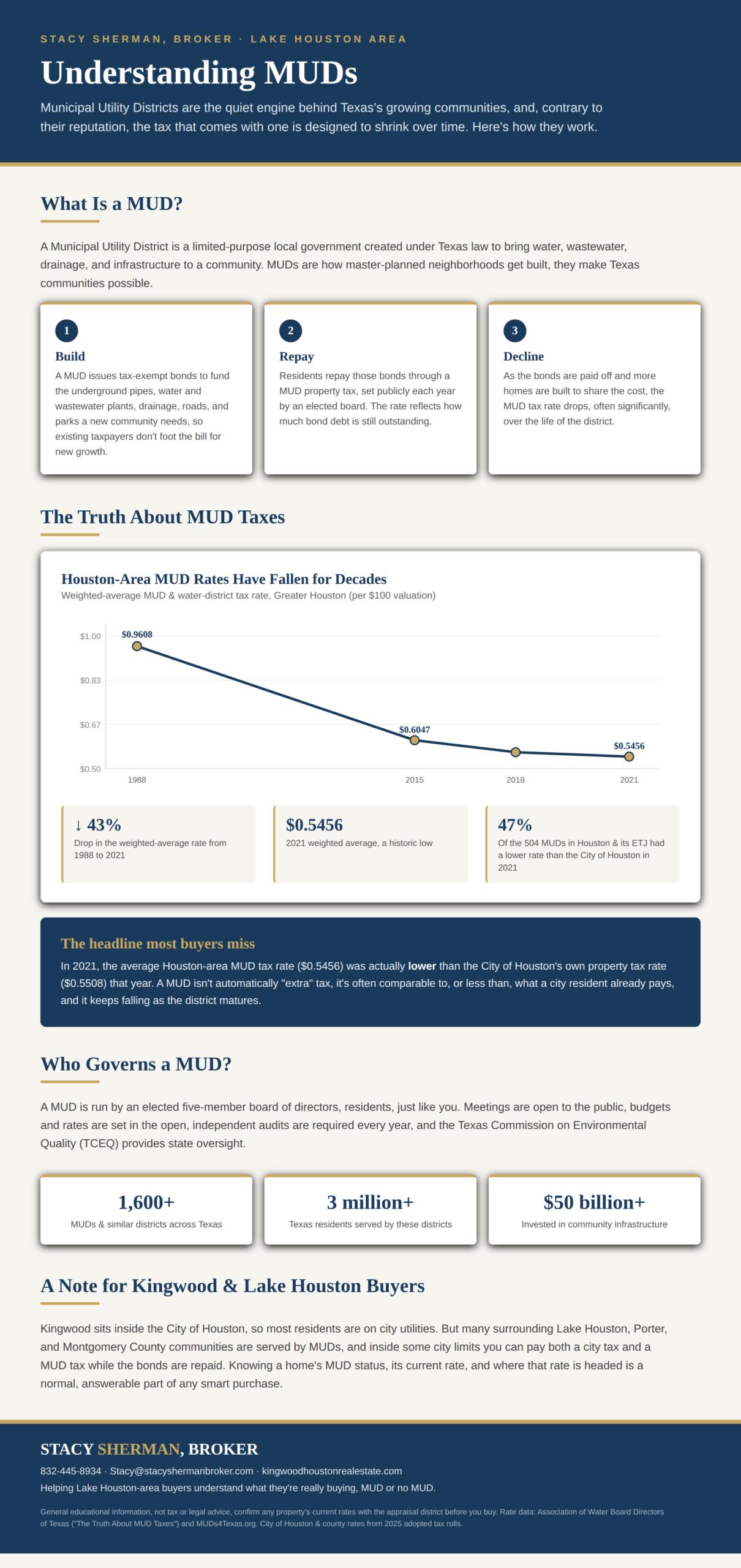
Share this guide, click to view full size.
6 Things to Check Before You Buy, Anywhere
Confirm the County & City Status
Know whether the home is in Harris or Montgomery County, and whether it’s inside a city’s limits or unincorporated, it drives both your services and your tax stack.
Get the Full Tax Rate Stack
Ask for every taxing entity on the bill, school district, county, city, hospital, flood control, college, and any MUD, not just the headline number.
Check the MUD Status & Rate
If there’s a MUD, get its current rate and its trend over the past several years, and ask where it is in paying off its bonds.
Apply the Exemptions
Homestead and other exemptions can meaningfully lower what you actually pay, make sure your estimate reflects them, especially on school taxes.
Weigh the Services You’ll Use
City police and fire, county sheriff and ESDs, drainage muscle, libraries, parks, value the services against the rate, not the rate alone.
Budget the All-In Monthly Number
Fold the true annual tax (MUD and all) into your monthly payment so the home you love is a home you can comfortably own.
A Worked Example: How the Math Comes Together
It’s easier to see the moving parts with a real example. Say a Kingwood home has an appraised (market) value of $400,000. Every taxing unit applies its own rate to your taxable value, so the calculation runs entity by entity and then adds up. Here’s the shape of it, using round numbers, treat it as illustrative, since each unit’s local exemptions differ and your exact figures come from the appraisal district.
| Appraised (market) value | $400,000 |
| Combined Kingwood tax rate (approx.) | ~$2.26 per $100 of taxable value |
| Estimated tax BEFORE exemptions | ~$9,040 per year |
| Homestead exemption (school portion) | −$140,000 of taxable value |
| School tax saved by the homestead alone | ≈ $1,547 per year (at Humble ISD's ~$1.1052 rate) |
| Plus local homestead exemptions | City and county units offer their own homestead exemptions, lowering the bill further |
| Estimated tax AFTER homestead & exemptions | Meaningfully less, often in the low-to-mid $7,000s (illustrative) |
The takeaway isn’t the exact dollar figure, it’s the mechanism. Your bill is appraised value, minus every exemption you qualify for, times the sum of the local rates. That means you have two levers you actually control: claim every exemption available, and challenge the appraised value when it’s too high. Everything else on the bill is set by the taxing units, in public, each fall.
Exemptions & Caps: The Levers You Control
The single most powerful lever is the homestead exemption. As of 2026 it removes $140,000 of value from your school taxes (raised from $100,000 by Proposition 13 in November 2025), and homeowners who are 65 or older or disabled get an additional $60,000, up to $200,000 in school exemptions for a qualifying senior, plus a school-tax ceiling that effectively freezes that portion of the bill. It’s free to file and it stays with the home until you move.
The second lever is the homestead appraisal cap: once your exemption is in place, the taxable value of your home can’t rise more than 10% per year, no matter how hot the market runs. In a fast-appreciating area, that cap can save you more over time than the exemption itself. And the third lever is your right to protest the appraised value every year if it looks too high. Used together, exemption, cap, and protest, these three tools are how ordinary homeowners keep their bills in check without any change to the underlying rates.
Where Your Property Taxes Actually Go
It’s easy to see property taxes as money that simply disappears, but it’s worth knowing what the bill actually buys, because in this area, a lot of it comes back to you. The largest share, by far, funds your school district; for Kingwood that’s Humble ISD, and strong schools are one of the biggest drivers of local home values, so that spending supports your investment even if you don’t have kids in class. The county portion pays for roads, courts, the sheriff, and county services, while the city portion (for those inside Houston) funds police, fire, parks, libraries, and, importantly here, large-scale drainage and capital projects.
A few smaller lines do outsized work. The Harris County Flood Control District’s slice, though modest on the bill, funds exactly the kind of drainage and mitigation work that matters most in a flood-prone region, arguably some of the best-spent money on the whole statement. The hospital district (Harris Health) helps fund care for the community, and a community-college line supports local higher education and workforce training. Seen this way, the bill isn’t just a cost; it’s the shared investment that keeps the Lake Houston area livable, safe, and worth what you paid for your home. For how a MUD fits alongside all of this, and how those rates decline over time, see the MUD guide.
Selling Your Current Home Before You Buy?
Property taxes are usually the second question buyers ask, right after price. The first question is often whether they need to sell the home they already own. The tax rate on your next house and the equity in your current one work together: a lower MUD rate can free up monthly budget, and the proceeds from your sale set how much you can put down.
If you own a home in Kingwood, Humble or Atascocita now, start with a free home valuation so you know your likely net before comparing tax bills on the next one. Stacy Sherman, Broker can also walk you through a seller net sheet and how selling a house with a mortgage works at closing, so the numbers for both homes sit side by side.
Buying in the Houston area? You May Have a Home to Sell First
Most people researching the houston area already own a home they will need to sell before they buy the next one. That is the ordinary shape of a move, not a complication, and the real work is timing the two halves so you move once. Before you shop, it helps to know your number.
A free home valuation or a more detailed broker opinion of value shows the equity you can carry forward, our flat-rate listing service keeps more of it in your pocket, and our guide to contingent offers explains how to buy your next home before this one closes. We handle both sides of the transaction on a single timeline, so the sale and the purchase work together instead of against each other.
Frequently Asked Questions
Is it better to be in the City of Houston or unincorporated county?
Neither is universally better, it’s a trade-off. Inside the city you pay a city tax but get full municipal services and big-project drainage muscle; unincorporated areas skip the city tax but often have a MUD and different service providers. The right answer depends on the specific home, its total tax stack, and the services you value.
Why is Kingwood in the City of Houston?
Kingwood was annexed into the City of Houston in the mid-1990s. Being part of the city has brought municipal services and, importantly, city engineering and capital to major drainage and flood-mitigation work, a real benefit for a low-lying area, alongside trade-offs like less-personalized EMS than the old volunteer model.
What makes up my property tax bill?
A stack of separate rates from every entity serving your address: the school district (usually the largest, ~half the bill), the county, the city (if you’re in one), the hospital district, flood control, a community college, and any MUD. For a typical Kingwood home in 2025 that’s roughly $2.26 per $100 of taxable value before exemptions.
Are property taxes lower in Montgomery County?
The base county math can be similar to or a bit lower than Harris County, but the MUD layer drives most of the variation. Mature Montgomery County MUDs can be very low, while newer master-planned communities can add $0.50 to $1.00+ per $100 while their bonds are being repaid. Always compare the all-in rate, not just the county.
Do MUD taxes go up or down over time?
Down, as a rule. MUD rates start high to fund brand-new infrastructure, then decline as the bonds are paid off and more homes share the cost. The Greater Houston weighted-average MUD rate fell from about $0.96 in 1988 to roughly $0.55 by 2021, a historic low. Our Understanding MUDs guide charts the full trend.
How do I find out if a home is in a MUD?
Ask your agent and check the appraisal district record for the property, which lists every taxing entity. If there’s a MUD, you can look up its current rate and recent history, and Texas law also requires sellers to provide a MUD notice disclosing the district and its rate. When you’re ready to run the numbers on a specific home, reach out and we’ll pull the full tax picture together.
A quick note: This is general educational information, not tax or legal advice. Tax rates change every year and vary by exact address. Always confirm a specific property's current rates and MUD status with the county appraisal district before you buy.