
MUD Taxes & Your Home Purchase: What Every Buyer Should Know
How a Municipal Utility District Affects Your Payment, Your Loan & Your Long-Term Value
Few things worry Lake Houston-area buyers like the letters “M-U-D” on a listing. The good news? Once you understand how MUD taxes really work, they become one more number you can plan around, and often a better deal than the reputation suggests.
★ 5.0/5.0
44 Client Surveys (HAR.com)
10+
Years Local Experience
Local Broker
Kingwood-Based, Not a Franchise
NAR • BPOR • SFR • ALHS
Certified Broker
First, Take a Breath About That MUD
If you’re shopping in the growing communities around Kingwood, Porter, New Caney, and the master-planned neighborhoods of Montgomery County, you’ll run into homes in a Municipal Utility District, or MUD. And if you’ve heard anything about MUDs, it’s probably that they mean “high taxes.” It’s worth slowing down on that, because the reputation is only half the story, and the half that gets left out is the encouraging part.
A MUD is simply the mechanism that paid to build your neighborhood’s water, sewer, and drainage, and residents repay that cost over time through a MUD property tax. Crucially, those rates are designed to fall as the district’s bonds are paid off. If you want the full background on what a MUD is and how it’s governed, start with our Understanding MUDs guide; this post is about the part that matters at the closing table: how a MUD affects your actual purchase.
The Myth vs. the Reality
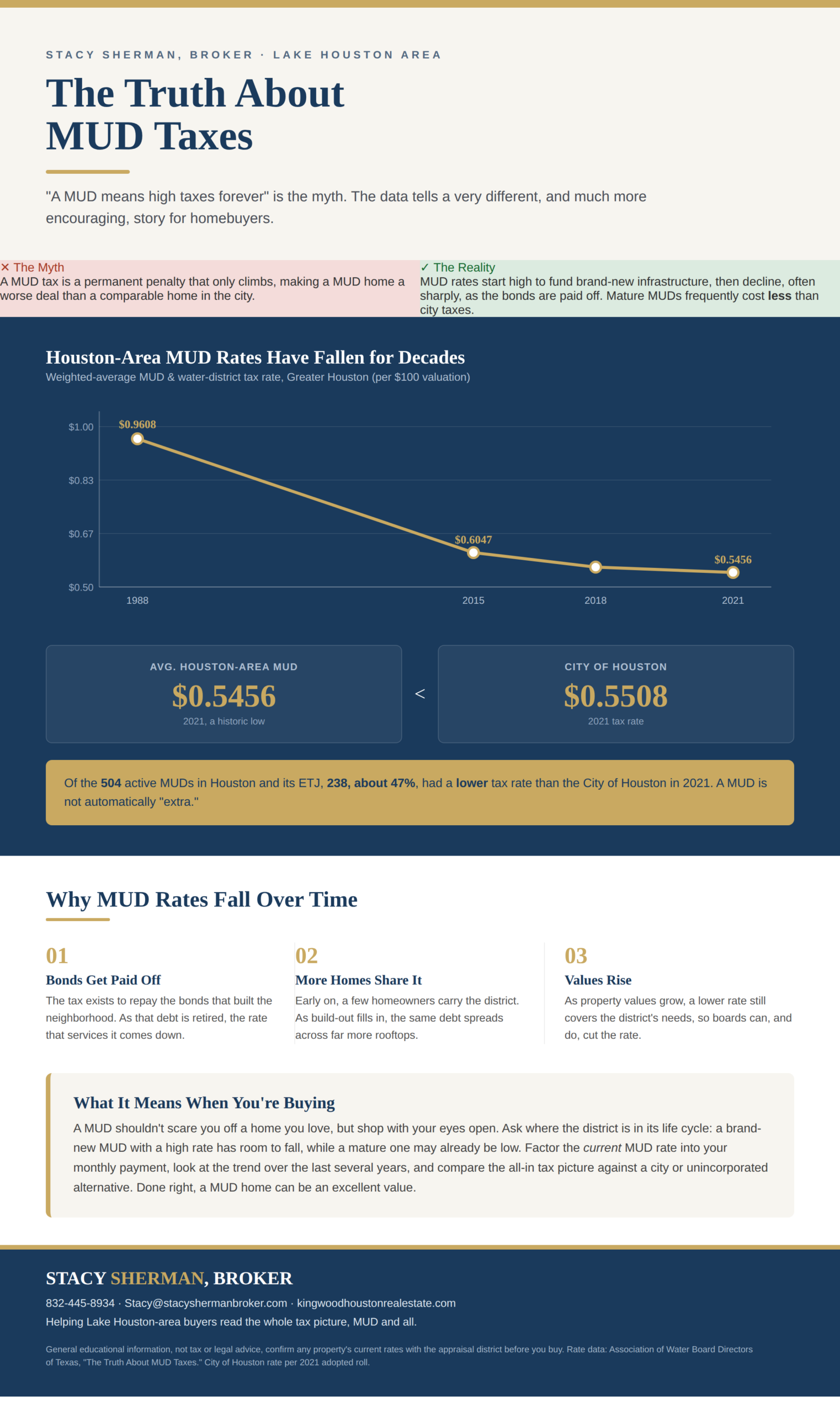
The myth is that a MUD is a permanent penalty that only climbs, making a MUD home a worse buy than a comparable home in the city. The reality is close to the opposite over time. MUD rates start high because a few early homeowners are funding brand-new infrastructure; as bonds are repaid and more homes share the load, the rate declines, often sharply. Across Greater Houston, the average MUD rate fell from about $0.96 per $100 in 1988 to roughly $0.55 by 2021, a historic low that was actually a touch below the City of Houston’s own tax rate that year. In other words, a mature MUD can cost you less than living inside the city.
The Truth About MUD Taxes, In One Picture
Click to view full size.
How a MUD Actually Affects Your Purchase
Where a MUD shows up in your transaction is the monthly payment. Property taxes, MUD included, are usually collected with your mortgage through an escrow account, so a higher combined tax rate means a higher monthly payment for the same purchase price. That matters for affordability and for loan qualification: lenders look at your total housing cost, taxes and all, when they calculate your debt-to-income ratio, so a steep MUD rate can slightly reduce the price you qualify for. The fix isn’t to avoid MUDs, it’s to know the number up front so your budget and your pre-approval reflect reality.
Two more places a MUD can touch your deal. First, resale: a very high MUD rate can make a home a little harder to sell later, while a low or falling rate is a quiet selling point, which is why the district’s trend matters as much as today’s number. Second, disclosure: Texas law requires sellers to give buyers a formal MUD notice stating the district and its tax rate, so you’re entitled to this information before you commit. When you know a home is in a MUD, you can weigh the full tax picture the same way you would compare interest rates, as a normal, quantifiable part of the decision.
How to Evaluate a MUD Before You Buy
Get the Current MUD Rate
Ask for the district’s exact rate per $100 and add it to the rest of the tax stack so you’re comparing homes on an all-in basis, not a headline number.
Look at the Trend
Pull the last five to ten years of the MUD’s rate. A steady decline is a great sign; it tells you where your bill is heading as the bonds pay down.
Ask How Much Debt Remains
A newer district with lots of outstanding bonds has a high rate with room to fall; a mature district may already be low. Both can be good buys, for different reasons.
Run It Through Your Payment
Fold the true annual tax into your monthly escrow estimate before you fall in love, so your pre-approval and comfort level reflect the real cost.
Compare MUD vs. Non-MUD Homes Fairly
A MUD home may be priced lower or offer more house for the money to offset the tax, compare total monthly cost, not just list price.
Read the MUD Notice
Review the seller’s required MUD disclosure carefully, and ask your agent to confirm the district and rate against the appraisal district record.
MUD or No MUD: Comparing Two Homes
Imagine two similar homes: one inside the City of Houston with no MUD, and one in a newer Montgomery County community with a MUD. The city home has a city tax line but no MUD; the MUD home skips or reduces some city costs but adds the district rate. The “cheaper” home isn’t whichever has the lower tax rate on paper, it’s whichever gives you the best total monthly cost for the home you actually want, once taxes, price, and even insurance are added up. Sometimes that’s the city home; often, in a maturing MUD, it’s the MUD home, especially when the builder or seller has priced it to account for the district.
This is exactly the kind of apples-to-apples comparison a local agent does for you. We’ll line up the total tax rate, the MUD trend, the price, and the monthly payment side by side so the decision is about the home and the lifestyle, not about being scared off by an acronym. And if you’re selling a MUD home, our flat-rate listing service and a current home valuation help you present that falling-rate story as the asset it is.
The Bottom Line for Buyers
A MUD should never be an automatic “no.” It’s a financing tool that built the community you’re considering, it’s governed openly by an elected board of your neighbors, and its rate is engineered to decline as the neighborhood matures. Handled with a little homework, the current rate, the trend, and the monthly impact, a MUD home can be one of the best values in the Lake Houston area. The goal isn’t to fear the number; it’s to know it, plan for it, and buy with confidence. When you find a home you love, we’ll gather the district details, run the all-in monthly cost, and lay the comparison out clearly, so the acronym on the listing never stands between you and the right home for your family.
MUD Tax Rates Have Been Falling for Forty Years
Here is the single most reassuring fact about MUD taxes, and it is one most buyers never hear: over the long run, MUD tax rates go down, not up. When a district is brand new, only a handful of homes exist to share the cost of the water lines, sewers, and drainage that were just built, so the rate starts high. As more homes fill in and the district pays off its construction bonds, that same debt is spread across more rooftops and steadily retired, and the rate falls year after year.
This is not a hopeful theory, it is what four decades of data show. According to the Association of Water Board Directors of Texas, the weighted-average tax rate across Greater Houston MUDs and water districts has declined dramatically since the 1980s:
| 1988 weighted-average MUD rate | $0.9608 per $100 of value |
| 2015 | $0.6047 per $100 |
| 2018 | $0.5595 per $100 |
| 2021 (a historic low) | $0.5456 per $100 |
That 2021 figure was a historic low, and it was reached even after the region absorbed Hurricane Harvey, Tropical Storm Imelda, Winter Storm Uri, and the Covid-19 pandemic. The reason MUD rates behave so differently from most taxes is structural: the large majority of a MUD’s tax goes to pay off construction debt rather than to ongoing operations, so once that debt is retired, the rate has nowhere to go but down. For a buyer, the practical takeaway is simple. A MUD rate is a snapshot of where the district sits in its life cycle, and in an established neighborhood you are often looking at a rate that has already done most of its falling.
How MUD Rates Stack Up Against the City of Houston
Buyers often assume that a home inside the City of Houston is the safer, cheaper tax bet and that a MUD automatically means paying more. The numbers tell a more interesting story. Of roughly 504 active MUDs inside Houston or its extraterritorial jurisdiction, about 238 of them, nearly half, actually carried a 2021 tax rate lower than the City of Houston’s own rate:
| Active MUDs in Houston and its ETJ | About 504 |
| MUDs with a 2021 rate below the City of Houston | About 238 (roughly 47%) |
| City of Houston 2021 tax rate | $0.55083 per $100 |
| Average MUD rate in Houston's ETJ (2021) | $0.54560 per $100 |
In other words, living in a MUD does not automatically mean a higher tax bill than the city, and in a large share of cases it means a lower one. The scale is easy to underestimate too: those 504 districts are home to well over two million people, and more than 1.2 million of them live in a MUD that taxes at a lower rate than Houston does. This is exactly why the city limits versus unincorporated question deserves a real look rather than a gut reaction. What matters is not the label on the neighborhood but the actual combined rate, the exemptions you qualify for, and where the district is in its bond life cycle. Run those numbers on the specific home, and a MUD often comes out looking a good deal friendlier than its reputation.
Frequently Asked Questions
Will a MUD raise my monthly mortgage payment?
Yes, indirectly, property taxes, including the MUD, are typically collected through your escrow account, so a higher combined tax rate means a higher monthly payment for the same price. Knowing the rate up front lets you budget accurately.
Can a MUD affect how much home I qualify for?
It can. Lenders include your total housing cost, taxes and all, in your debt-to-income ratio, so a high MUD rate can modestly lower the price you qualify for. Get pre-approved with the real tax figure so there are no surprises.
Do MUD taxes go down over time?
Generally, yes. Rates start high to fund new infrastructure and decline as bonds are repaid and more homes share the cost. The Greater Houston average fell from about $0.96 in 1988 to roughly $0.55 by 2021, our Understanding MUDs guide charts the full decline and explains why it happens.
Does a MUD hurt resale value?
A very high rate can make a home slightly harder to sell, but a low or clearly declining rate is a selling point. The trend matters as much as today’s number, a maturing MUD tells a positive story to the next buyer.
How will I know if a home is in a MUD?
Texas law requires sellers to provide a MUD notice disclosing the district and its rate, and the appraisal district record lists every taxing entity. Your agent can confirm both before you write an offer.
Is a MUD home a worse deal than a city home?
Not necessarily. Compare total monthly cost, taxes, price, and insurance, not just the tax rate, as our city-vs-county and property-tax guide explains. A maturing MUD home is often priced to offset the district and can be an excellent value; sometimes the city home wins. It depends on the specific homes, which is exactly what we help you compare.
Found a Home in a MUD? Let's Run the Numbers.

- How to Value Commercial Property in Houston: Cap Rate, NOI, and the Mistakes That Cost Owners the Most - September 27, 2026
- For Sale By Owner in Texas: What Selling Without an Agent Really Costs - September 27, 2026
- Contingent Offers in Texas: How to Buy Before Your Current Home Sells - September 27, 2026
Related posts:
- Where to Live in Greater Houston: A Neighborhood-by-Neighborhood Guide for 2026
- Home Inspections in the Lake Houston Area: The Option-Period Playbook for Buyers
- Apartments and Rentals in Trailwood Village, Kingwood: A Guide for Renters, Owners and Investors
- Kingwood Lakes Apartments and Rentals, Kingwood TX: A Guide for Renters, Owners and Investors