
Texas Rental Agreements & Landlord Screening: Best Practices
How to Protect Your Investment With a Strong Lease and a Fair, Consistent Screening Process
A great rental starts long before a tenant moves in, with a clear lease and a fair, consistent screening process. This guide walks landlords through both, so your property, your income, and your peace of mind are protected.
★ 5.0/5.0
44 Client Surveys (HAR.com)
10+
Years Local Experience
Local Broker
Kingwood-Based, Not a Franchise
NAR • BPOR • SFR • ALHS
Certified Broker
Why Your Lease and Screening Process Matter
Whether you own a single rental home in Cleveland or a growing portfolio across the Lake Houston area, two documents determine most of your success as a landlord: the lease you sign and the screening criteria you use to choose a tenant. Get those right and the rest of the relationship usually runs smoothly. Get them wrong and a single problem tenant or an ambiguous clause can cost you months of income and thousands in repairs or legal fees.
Texas gives landlords and tenants considerable freedom to set their own terms, which means the written lease governs almost everything, so vague or missing clauses work against you. At the same time, tenant screening is governed by fair-housing law, so your process must be consistent and applied the same way to every applicant. The good news: a strong, standardized approach protects you legally and gets you better tenants. If you’re weighing an investment property or already own rentals, the practices below are the foundation.
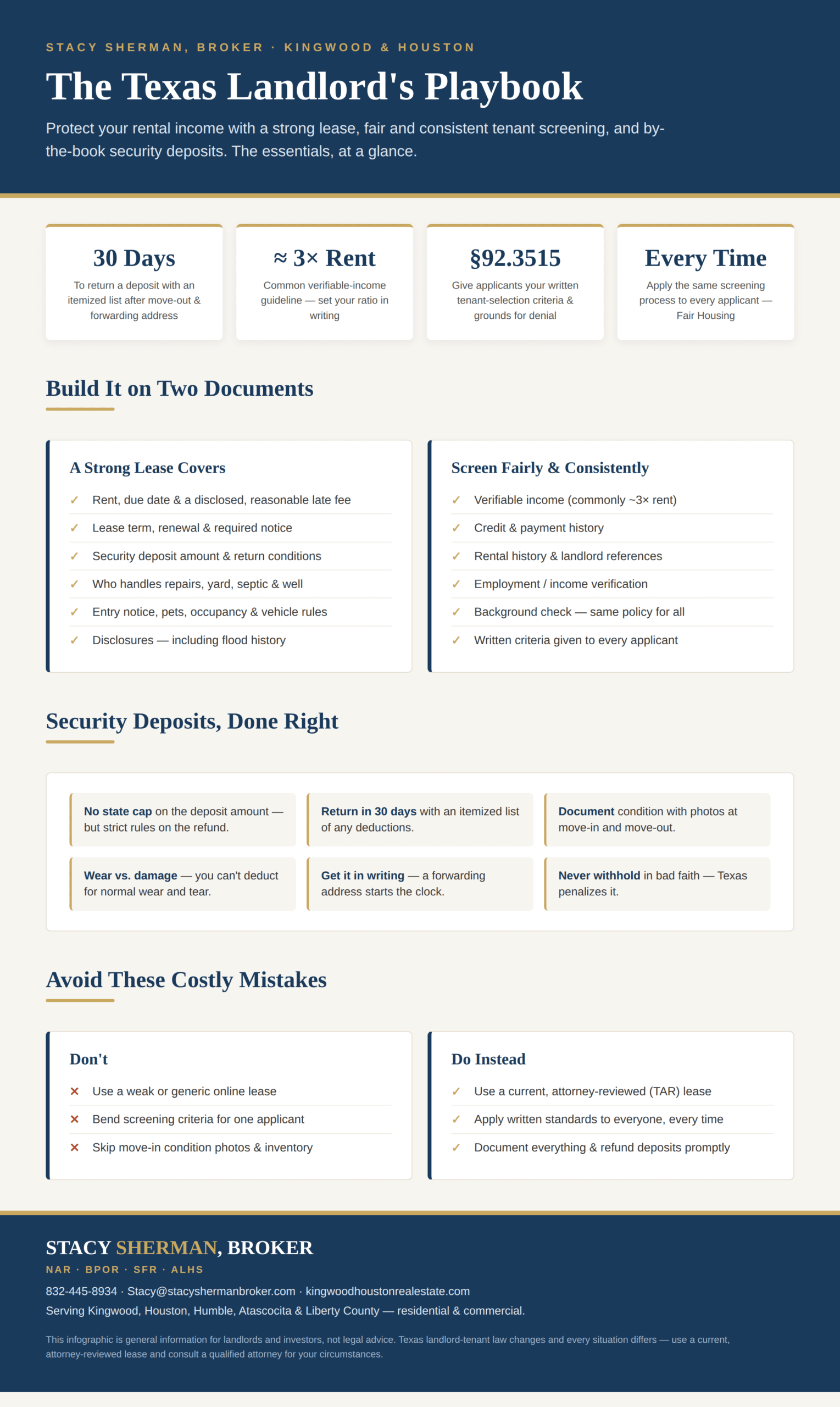
What a Strong Texas Lease Should Cover
Rent, Due Date & Late Fees
State the exact rent, when and how it's paid, any grace period, and a late fee that is disclosed in the lease and reasonable. Texas law requires late fees to be spelled out in the lease, don't improvise them later.
Term & Renewal
Define the lease length, what happens at the end (month-to-month conversion or renewal), and the notice each side must give to end or change the tenancy.
Security Deposit
State the deposit amount and the conditions for its return. Texas sets no cap on the amount but does regulate how and when it must be refunded, handle it precisely (see below).
Maintenance & Repairs
Spell out who handles what, landlord repair obligations, tenant upkeep (yard, filters, pest), and how to request repairs. For rural properties, address septic pumping and well maintenance specifically.
Entry & Access
Set reasonable notice for inspections and non-emergency entry so both sides know the expectation.
Occupancy, Pets & Property Rules
Define who may live there, pet and animal policies (with any deposit or rent), vehicle/RV rules, smoking, and subletting, the areas that cause the most disputes.
Disclosures & Addenda
Include required disclosures and any property-specific addenda (flood history is a fair and increasingly expected disclosure anywhere in the Liberty County and Lake Houston area).
Landlord Screening Criteria, Fair, Consistent, and Legal
Tenant screening is where good landlords protect themselves and where careless ones get into trouble. The guiding rule is simple: decide your criteria in writing before you advertise, then apply them identically to every applicant. Federal and Texas fair-housing law prohibit treating applicants differently based on race, color, religion, sex, national origin, disability, or familial status, so a consistent, documented process isn’t just fairer, it’s your best legal defense.
Texas law also expects transparency with applicants. Landlords are generally required to make their tenant-selection criteria available and to notify applicants of the grounds on which an application may be denied (Texas Property Code §92.3515). Put your standards in writing, hand them to every applicant, and stick to them. Reasonable, commonly used criteria include verifiable income (many landlords look for gross monthly income of roughly three times the rent), credit and payment history, prior rental history and landlord references, employment or income verification, and a background check applied under the same policy for everyone.
The point isn’t to make screening harder, it’s to make it objective. When your decision rests on written criteria applied the same way every time, you choose better tenants and you can clearly explain any denial. For day-to-day execution, some owners self-manage while others use a professional property manager; either way, the screening framework should be the same.
A Practical Screening Checklist
| Income | Verifiable gross monthly income, commonly around 3x the monthly rent, set your ratio in writing and apply it consistently. |
| Credit & Payment History | Review for patterns (not a single number in isolation); define your threshold in advance. |
| Rental History | Contact prior landlords about payment, care of the property, and notice given, references are often the most predictive signal. |
| Employment / Income Verification | Confirm income with pay stubs, an offer letter, or bank statements per your stated policy. |
| Background Check | Apply the same criteria to every applicant, following fair-housing and applicable screening rules. |
| Written Criteria & Notice | Provide your tenant-selection criteria to every applicant and note the grounds for denial (Texas Property Code §92.3515). |
Security Deposits, Done Right
Security deposits generate more landlord-tenant disputes than almost anything else, and Texas has clear rules worth following to the letter. There’s no statutory cap on the deposit amount, but once a tenant moves out and provides a forwarding address, the landlord generally must refund the deposit, along with an itemized list of any deductions, within 30 days. Deductions can cover damage beyond normal wear and tear and amounts the tenant owes under the lease, but not ordinary wear from living in the home.
Protect yourself by documenting the property’s condition in writing and with photos at both move-in and move-out, so any deduction is defensible. Keep receipts for repairs, return the deposit and itemization promptly, and never withhold in bad faith, Texas law penalizes landlords who wrongfully retain a deposit. Clear documentation and prompt, itemized refunds keep you compliant and keep good tenants willing to rent from you again.
Common Landlord Mistakes to Avoid
Using a Weak or Generic Lease
A cheap online template often misses Texas-specific provisions. Use a current, attorney-reviewed lease such as the Texas Association of REALTORS® form.
Screening Inconsistently
Bending your criteria for one applicant and not another is both risky and, potentially, a fair-housing violation. Apply written standards every time.
Skipping the Move-In Documentation
No photos or condition report means deposit disputes become your word against theirs, document everything up front.
Mishandling the Deposit
Missing the 30-day refund window or failing to itemize deductions exposes you to penalties. Track move-out dates and forwarding addresses carefully.
Ignoring Property-Specific Risks
For rural Liberty County rentals, address septic, well, and flood matters in the lease and disclosures rather than leaving them ambiguous.
Please note: This guide is general information for landlords and investors, not legal advice. Texas landlord-tenant law changes and every situation is different. Use a current, attorney-reviewed lease (many Texas landlords use the Texas Association of REALTORS® residential lease), and consult a qualified attorney for your specific circumstances.
For Investors & Portfolio Landlords
If you’re building a rental portfolio in the Lake Houston and Liberty County area, where Cleveland’s rental market has been especially active, the same fundamentals scale up: a strong standardized lease, consistent screening, and disciplined deposit handling across every unit. Systematizing these from the start saves enormous headaches as you grow.
Stacy Sherman helps investors on both the acquisition and the operating side: evaluating an investment property before you buy, connecting you with property management for day-to-day operations, and, when it’s time to reposition or sell a rental, providing a broker opinion of value so you know exactly what your asset is worth. Explore current houses for rent in Liberty County and the full rental resource hub for more.
Frequently Asked Questions
How much can a landlord charge for a security deposit in Texas?
Texas does not set a statutory cap on the security deposit amount. However, it regulates how the deposit is handled, most importantly, refunding it with an itemized list of deductions within 30 days after the tenant moves out and provides a forwarding address.
When must a Texas landlord return the security deposit?
Generally within 30 days of the tenant surrendering the property and providing a forwarding address. Deductions must be itemized in writing. Wrongfully withholding a deposit in bad faith can expose the landlord to penalties.
What screening criteria can a landlord legally use in Texas?
Landlords may consider objective, consistently applied factors such as income, credit and payment history, rental history and references, and background checks, but must not discriminate based on protected classes under fair-housing law. Texas also expects landlords to make their tenant-selection criteria available to applicants and note the grounds for denial (Property Code §92.3515).
What should every Texas lease include?
At minimum: rent amount and due date, disclosed and reasonable late fees, lease term and renewal terms, the security deposit and its conditions, maintenance responsibilities, entry/access notice, occupancy and pet rules, and any required disclosures and property-specific addenda.
Do I need flood disclosure for a Liberty County rental?
Flood history is a fair and increasingly expected disclosure anywhere in the Liberty County and Lake Houston area. Being upfront about flood risk protects you and builds trust with tenants, include it in your disclosures.
Should I self-manage or hire a property manager?
Both work. Self-managing saves the management fee but requires your time and systems; a professional property manager handles screening, maintenance, and compliance for you. Either way, use the same strong lease and consistent screening standards.